
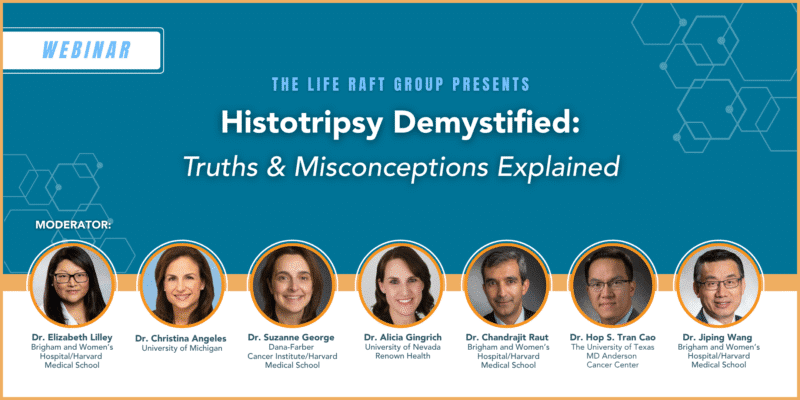
The Life Raft Group hosted a webinar bringing together top experts in a new procedure called histotripsy. The objective of the discussion was to provide clear, realistic, and compassionate answers about what histotripsy can and cannot do. This webinar was created in direct response to overwhelming interest and thoughtful questions from our community.
Moderator: Dr. Elizabeth Lilley of Brigham and Women’s Hospital
Panelists:
• Dr. Jiping Wang (co-lead, Mass General Brigham Histotripsy Program)
• Dr. Chandrajit Raut (Brigham and Women’s Hospital/Harvard Medical School)
• Dr. Hop Tran Cao (MD Anderson Cancer Center)
• Dr. Christina Angeles (University of Michigan)
• Dr. Alicia Gingrich (University of Nevada/Renown Health System)
• Dr. Suzanne George (Dana-Farber Cancer Institute)
Summary
What Is Histotripsy?
Histotripsy is a noninvasive procedure that uses a new form of focused ultrasound energy to destroy tumor tissue, without damaging surrounding tissue. The ultrasound energy is delivered via a software-guided machine which destroys the tumor at the cellular level, often in just one session. The cellular debris from the destroyed tumor is then absorbed by the body.
Right now, histotripsy is approved by the FDA to treat cancers of the liver only. Liver tumors are the logical first use of histotripsy because the liver is a large uniform organ which has excellent regenerative qualities and can be easily accessed with the histotripsy machine. Doctors do not recommend partial treatment of a tumor because leftover cancer cells may continue to grow. Initial clinical study showed high success rate after 1 year and low complication rate. Long terms outcomes are still being studied.
What are the requirements when histotripsy is used to treat liver cancer?
To be eligible for histotripsy, liver lesions must be smaller than 3 centimeters, visible on an ultrasound, and not near critical structures like the bowels. Since patients undergoing histotripsy must be completely still, general anesthesia and intubation are required. If a patient is not a good candidate for general anesthesia due to underlying heart or lung problems, they are also not a safe candidate for histotripsy.
Can histotripsy be used to treat GIST?
GIST tumors may occur anywhere in the digestive tract, most commonly the stomach (40-70%) or the small intestine (20-40%). At this time, those body areas are not FDA approved to be treated using histotripsy. But if GIST spreads to the liver, doctors might consider histotripsy. The panelists emphasized that this decision should be made after a multidisciplinary discussion including both medical oncology and surgical oncology clinicians about the full range of treatment options, based on the location of the lesion, the size of the lesion, and what other drugs or clinical trials could be considered options. Histotripsy is not recommended for localized primary tumors that can be safely removed using surgery.
Can histotripsy be used to treat other sarcomas?
For sarcoma and other cancers, research is in early stages. There are many different subtypes of sarcoma, and sarcomas can behave in widely different ways so doctors have been testing histotripsy on sarcoma tissue that has been removed surgically to see what happens to the different subtypes. In another preclinical research study, doctors have started animal testing. In addition, doctors are working on developing a safe clinical trial protocol.
What is the abscopal effect and is there data that histotripsy induces it?
The abscopal effect is a hypothesis that a treatment on one tumor could somehow activate your body’s immune system to go after cancer elsewhere in the body. There is some thought that there could be an abscopal effect for histotripsy because you’re not destroying the tumor with heat so you’re not modifying the antigen. None of the panelists have seen this effect among their patients and cautioned people to be skeptical.
How can patients stay informed about the progress of histotripsy research and the results?
Patient-facing webinars and other forums where doctors speak about their research are good ways to keep up to date. The general consensus is that it will be at least one year before there is a clinical trial. Doctors learn a lot from outcomes data from current patients so please consider participating if your doctor asks you to take part in a registry trial.
Thank you to our moderator and panelists for a great, well-rounded discussion, and thank you to our patient community for joining us!