NF1-associated GIST Findings Presented by The Life Raft Group
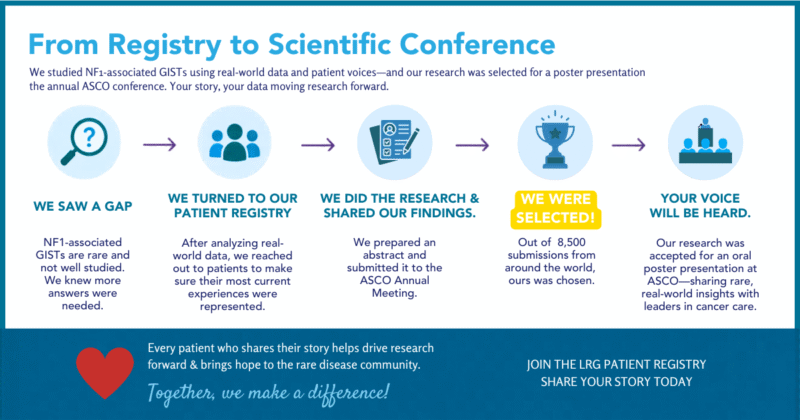
When our team started looking more closely at NF1-associated gastrointestinal stromal tumors (GISTs), one thing became clear right away: there were far more questions than answers.
NF1-associated GIST is a rare subtype of GIST, which means there is still limited information available about it compared with other cancers and even other types of GIST, such as KIT-mutant GIST. Because of this lack of knowledge, we felt it was important to take a deeper look and learn more about the disease and the experiences of patients living with it.
To do this, we turned to our Patient Registry to learn more. By studying real-world patient data, we were able to better understand the experiences, characteristics, and outcomes of people living with NF1-associated GISTs. But we didn’t rely on data alone. We also reached out directly to patients to make sure the information in our registry reflected their most up-to-date experiences. Their participation helped make this research stronger and more meaningful. We then ran multiple statistical analyses and summarized all the data.
Researchers from Memorial Sloan Kettering Cancer Center had also been studying NF1-associated GIST, so we decided to collaborate. Together, we reviewed our findings and prepared an abstract, which is a short scientific summary of the study. An abstract gives an overview of why the study was done, how the research was carried out, what was found, and what the results may mean for patients and future research.
Once we had our findings ready, we submitted them to the Annual Meeting of the American Society of Clinical Oncology (ASCO), one of the largest and most respected cancer conferences in the world. Then we waited while thousands of research projects from around the globe were reviewed.
Out of about 8,500 submissions, ours was selected.
Our research, titled “Clinical Characteristics and Outcomes of Germline and Sporadic NF1-Associated Gastrointestinal Stromal Tumors: Insights from a Real-World Patient Registry,” was accepted for an oral poster presentation. This gave us the chance to share what we learned about this rare type of GIST with doctors, researchers, and cancer experts from across the world.
This milestone shows why research into rare diseases matters. It also highlights the power of patient registries. Every patient who shares their experience helps us better understand rare cancers and move research forward.
Your Story Has An Impact on the GIST Community & GIST Research!