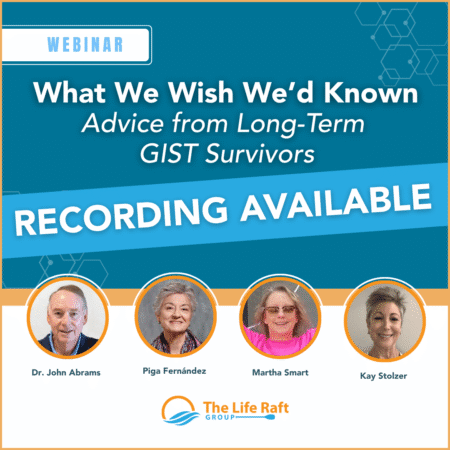
The LRG hosted three long-term GIST survivors on a recent webinar and had an honest conversation around what to do after a GIST diagnosis, common mistakes to avoid, and what it’s like to live with cancer long-term.
The Diagnosis Stories of Long-Term GIST Survivors
For all three panelists, a diagnosis came abruptly.
 Kay’s tumor was discovered during an endoscopy related to another issue. “I did what everyone does when they’re first diagnosed and googled GIST. The more I learned, the more afraid I became,” she said. Without mentors or a support network, she was treated by doctors that were not GIST experts and received erroneous information. Eventually, she found The Life Raft Group and said, “I believe The Life Raft Group saved my life just through knowledge and connections with other GISTers.”
 John’s diagnosis came in 1997, before GIST was recognized as its own disease. After having pain for six to 12 months, he had an endoscopy which found a tumor. He had surgery to remove it the same day. He also underwent months of chemotherapy that we now know is not recommended for GIST.
 Martha was 57, healthy, and teaching fitness classes when emergency surgery revealed a large, small‑bowel GIST. “I woke up to hear my name and cancer in the same sentence,” she recalled. “It’s the blow of a lifetime.”
The Most Important Advice for Newly Diagnosed Patients
All three panelists emphasized that new patients should see a GIST specialist as soon as possible.
Martha’s local oncologist had limited experience treating GIST patients and was not aware of mutation testing, so she initiated it herself. When he was not interested in the results of the test, she trusted her instincts and referred herself to MD Anderson. “You think if you go to a specialist, the news is going to be worse…but actually, it’s just the opposite because once you see a specialist, you know you’ve done everything you can,” she said. “You can go on with your life.”
John, who mentors other GIST patients, often sees the same pattern: “Most people like their physicians, so they trust them, as they should. But there are plenty of oncologists that don’t know much about GIST. The two keys to survival are specialists and biomarker testing.”
Kay echoed this: “Do not be afraid to hurt your oncologist’s feelings. You have cancer and they’re going to go home at night and it’s not going to affect their life. It is absolutely going to affect your life. So, don’t be afraid to hurt your oncologist’s feelings and get a second opinion. And any doctor worth their salt would encourage you to get a second opinion and a third opinion if that’s what you need.”
Find a GIST specialist in the LRG GIST Specialist Database: https://liferaftgroup.org/gist-specialist-list-us/
Living with GIST Long‑Term
Kay, John and Martha have been living with GIST for decades and shared their coping strategies in this webinar.
John maintains a “healthy sense of denial”: “There isn’t a day that goes by that I don’t think about it for one reason or another, but it doesn’t define me, and it doesn’t control me.”
Martha said “I think the best way to address that feeling of worrying about it all the time is to know you’ve done the best you can for yourself. You must eat healthy. You’ve got to exercise even though you don’t feel like it. You’ve got to get out with other people. That’s the only part of your longevity that you really have any control over.”
Kay has learned how to compartmentalize to handle scanxiety*. “I really don’t get anxious when I get a scan. I’ve decided to wait until I see the results or I hear from my doctor. I have decided not to get excited until I have a fact. That’s how I handle it.”
*Scanxiety is the stress and uncertainty many people feel around medical scans and test results. It is that feeling of worry before a scan, while waiting for answers, or wondering what comes next.
The Power of Community
Each panelist spoke about the profound impact of connecting with other GIST patients through The Life Raft Group.
John didn’t discover The Life Raft Group until 20 years into his journey with GIST, but once he did, it transformed his experience. “The Life Raft Group has enhanced my life beyond what I can I can talk about. It’s just been phenomenal for me.”
Kay recommended Life Fest, which will be held in Nashville this summer: “It’s a sacred space where you are safe to be with other people just like you. And there’s no “grocery-store talk”. You get to the real meat of the issue right away with people. There’s no pretense. There’s just a common bond that we all feel with each other.”
Martha said this about Life Fest: “Once all the layers are peeled back and we’re all human again, it’s just the greatest bunch of people in the world. It’s just the most important thing in the world to have peers.”
You can find more details about Life Fest registration & info: https://bit.ly/LifeFest2026GIST here.
Every GIST journey is different, but one thing is clear: learning from others matters. The experiences shared by long-term survivors remind us to ask questions, seek expert care, speak up for ourselves, and lean on support when we need it. If you are newly diagnosed or feeling uncertain, know that others have walked this path before you and you do not have to face GIST alone.
Have a question for long-term GIST survivors?
Ask what is on your mind. Their experiences may help guide, reassure, or support someone else on the journey too.
Use this link to ask your questions.
This article is a summary of the actual webinar that took place last month. You can watch the recording here.
Other Resources for Patient Support:
GIST Mentor Program
GIST Chat
Support Groups
Facebook Survivor Chat Group