
Introduction
GISTs are rare tumors that arise in the digestive tract, most commonly in the stomach or small intestine. While many GISTs are driven by mutations in the KIT or PDGFRA genes, a subset lacks these mutations and instead has deficiencies in an enzyme called succinate dehydrogenase (SDH). These tumors, known as SDH-deficient GISTs, have unique characteristics and require specialized approaches for diagnosis and treatment.
In February of 2025, The Life Raft Group collaborated with SDH-deficient GIST experts to develop an algorithm for structuring genetic testing in SDH-deficient GIST patients. This study provides a critical framework to ensure appropriate testing and management strategies for affected individuals and their families.
Key Takeaways for Patients and Families
1. SDH-deficient GISTs are a unique subtype that behave differently from other types.
2. Stomach tumors that fit the criteria should undergo SDHB immunohistochemistry testing.
3. Genetic testing is essential for confirming diagnoses, guiding treatment, and identifying hereditary risks.
4. Family members may need testing if hereditary mutations are found.
5. Current treatment options are limited, but ongoing research is exploring better therapies.
6. Consulting a GIST specialist or genetic counselor is highly recommended for personalized care.
What is this Study About?
This study emphasizes the importance of genetic (genomic) testing in SDH-deficient GISTs. SDH deficiency occurs when the tumor lacks a functioning SDH enzyme, which plays a crucial role in cellular energy production. The study also introduces a step-by-step algorithm to help doctors determine when and how to use genetic testing in SDH-deficient cases.
The Importance of SDHB Immunohistochemistry Testing
SDHB immunohistochemistry testing is a critical and accessible diagnostic tool for identification / diagnosis of SDH-deficient GISTs, particularly in patients who do not have access to advanced mutational testing like next-generation sequencing (NGS).
This test helps determine SDH deficiency by evaluating SDHB protein expression in tumor tissue. If SDHB expression is lost, it suggests an underlying SDH deficiency, warranting further genetic testing.
Why is SDHB immunohistochemistry important?
- Accessibility: It is widely available and more affordable than comprehensive genetic testing.
- Rapid Diagnosis: Provides a quick and effective method for identifying SDH-deficient GISTs.
- Guides Further Testing: Loss of SDHB expression, ( i.e., SDHB negative) indicates the need for additional genetic testing to determine the specific SDH gene mutation.
Why is this important to patients?
- Identifying SDH deficiency allows doctors to provide an accurate diagnosis and tailor treatment plans.
- SDH-deficient GISTs do not respond well to standard treatments like imatinib (Gleevec), which is effective in most other GIST types.
- Some SDH-deficient GISTs are hereditary, making genetic testing important for family members who may be at risk.
Understanding GISTs
GISTs originate from specialized cells in the digestive tract that regulate movement and digestion. These tumors can have different genetic mutations, affecting their behavior and treatment response.
While most GISTs are driven by KIT or PDGFRA mutations, a subset—5-10% of all GIST cases—lack these mutations and instead have SDH deficiencies. These tumors require specialized diagnostic and therapeutic approaches.
What Is SDH And Why Is It Important?
Succinate dehydrogenase (SDH) is an enzyme that plays a role in cellular energy production through the citric acid cycle and electron transport chain. When SDH is deficient, cells cannot produce energy efficiently, which may contribute to tumor development.
Characteristics Of SDH-Deficient GIST:
- More commonly occur in the stomach
- Frequently found in young female patients, including children and young adults; however, males are also diagnosed
- Tend to grow slowly but can spread to the liver and lymph nodes
- Do not respond well to standard GIST treatments like imatinib (Gleevec)
How Common Is SDH-Deficiency In GIST?
SDH-deficient GISTs account for 5-10% of all GIST cases and are most frequently seen in:
- Pediatric and young adult patients (under 30 years old)
- Patients with inherited syndromes such as Carney-Stratakis Syndrome and Carney Triad, which increase susceptibility to GIST and other tumors
Hereditary SDH-Deficient GIST And Syndromes
Some SDH-deficient GISTs are associated with hereditary conditions, meaning they can be passed down in families.
The most well-known hereditary condition is Carney-Stratakis Syndrome, which increases the risk of developing both GISTs and paragangliomas (tumors in nerve tissue).
- Genetic counseling and testing may be recommended for family members if an inherited mutation is found
- Understanding hereditary risk allows families to take preventive measures and monitor for early signs of tumors.
Why Is Genetic Testing Important For GIST Patients?
Genetic testing plays a crucial role in managing SDH-deficient GISTs by:
1. Confirming the diagnosis – SDH deficiency helps doctors determine the most effective management strategy.
2. Guiding treatment – Since SDH-deficient GISTs do not respond to standard therapies, alternative approaches may be necessary.
3. Identifying hereditary risks – Some SDH- deficient GISTs result from inherited mutations, which means other family members may be at risk.
What Does the Study Suggest About Genetic Testing?
The study introduces an algorithm to guide when and how genetic testing should be performed:
1. All SDH-deficient GIST patients should undergo genetic testing, regardless of age.
2. If a mutation is found in the SDH genes, family members may need genetic testing to assess their risk.
3. If a tumor is SDH-deficient but no mutation is detected, further specialized testing may be required.
Conclusion
This study underscores the critical role of genetic testing in diagnosing and managing SDH-deficient GISTs. Since these tumors do not respond well to standard treatments and may have hereditary links, understanding their genetic profile is essential for both patients and their families.
If you or a loved one has been diagnosed with a GIST, particularly at a young age or with a family history of similar cancers, genetic testing and counseling may offer crucial insights for treatment and future care.
For more information, consult your healthcare provider or a genetic counselor specializing in GIST and hereditary cancer syndromes. If you have any questions about your SDH-Deficient GIST, please email me at devans@liferaftgroup.org
A Simplified and Consolidated Algorithm for Genomic Testing in SDH-Deficient GIST
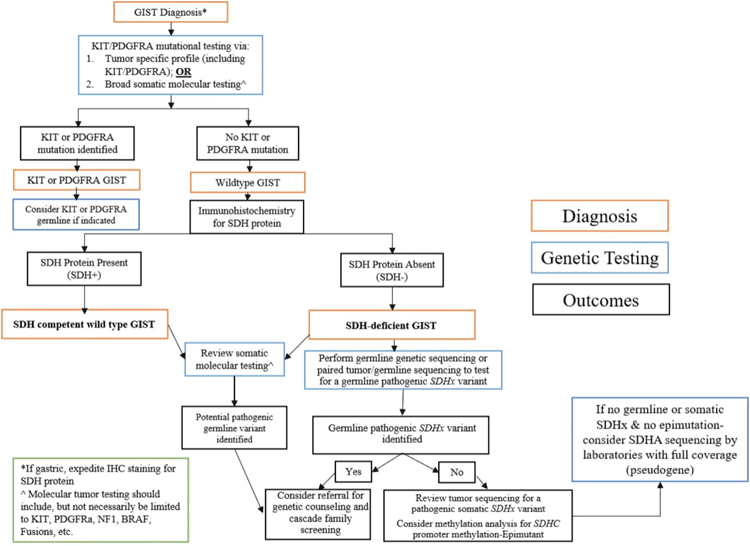
Florou, V., Jacobs, M. F., Casey, R., Evans, D., Owens, B., Raygada, M., Rothschild, S., & Greenberg, S. E. (2025). A review of genomic testing and SDH-deficiency in gastrointestinal stromal tumors: Getting to the GIST. Cancer Medicine, 14(3), 123-135. To read the full article: https://doi.org/10.1002/cam4.70669