In our monthly patient and caregiver stories, we share our community’s stories because each GIST journey matters. Your experiences as a rare disease patient or caregiver create a tapestry of strength, resilience, and shared understanding. By sharing, you not only break the chains of isolation but become a beacon of hope for others facing similar challenges. Together, these collective narratives shape a powerful force that drives awareness, research, and advocacy. Your voice matters, and by sharing your story, you contribute to building a stronger, more connected, and empowered rare disease community. Help others realize that even though they battle a rare disease & that each GIST case is unique, they are not alone.

Our Caregiver of the Month for April is Gentry Trice. Here is her GISTory:
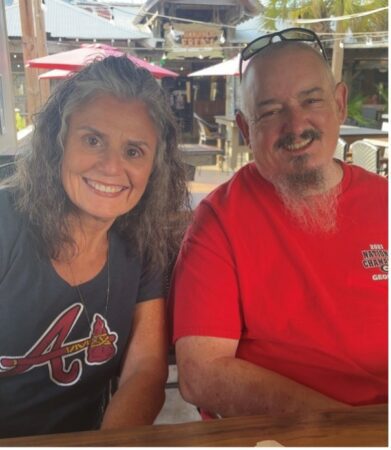
Gentry and Anthony, Florida.
My Husband Anthony’s GISTory
In October of 2016, when my husband Anthony was 49 years old, he started suffering from severe abdominal discomfort, pain, fullness, nausea, and unexplained weight loss. After several trips to the urgent care and appointments with his primary physician, a CT scan was finally ordered. Based on this scan, it determined that he had a mass of some type in the lower right quadrant of his stomach which needed to be removed. The surgery was scheduled for a few days later to remove it. We had no information except that the growth was large. The surgeon referred to it as the size of a “baby’s head”. Once Anthony was in surgery, it was discovered that it was attached to his small intestinal wall. Fortunately, the surgeon was able to successfully remove the 11 cm mass with clear margins. Once the pathology report was completed, this mass was determined to be consistent with malignant Gastrointestinal Stromal Tumors (GIST). At that time, neither of us had ever heard of GIST tumors and discovered that most oncologists have very limited experience in treating them. Still not really understanding the true diagnosis, we followed the oncologist’s lead and Anthony began targeted chemotherapy treatment through imatinib which he took for the next seven years. He continued to have positive CT scans every 3 – 6 months so treatment was stopped in early 2024.
This trend continued until March of 2025 when a CT scan revealed diffused peritoneal metastatic disease. There were three specific tumors identified in the scan with measurements ranging in size from 3 cm to 8 cm. Anthony began taking imatinib again. We were informed that he was not a candidate for surgery and were basically told to “wait and see” if the tumors begin to shrink with the current treatment. At this point we were still in shock over this recurrence, and over the next few months Anthony began having medical issues. There were episodes of major confusion, extreme lethargy, and unexplained weight loss. After several hospitalizations, it was discovered that he had high ammonia levels in his liver which appeared to be causing these symptoms. Multiple CT scans and MRIs showed no cirrhosis of the liver which was initially thought to be the culprit. In May of 2025, he was hospitalized again with a partial bowel blockage caused by one of the GIST tumors. At this point, we were very frustrated and determined that it was time to get some help outside of the central Georgia area. He also applied for an early retirement from his job at Robins AFB due to the impact his symptoms were having on his ability to work.
One day in May when Anthony was asleep in the hospital, I was scrolling through Facebook and found The Life Raft Group. I reached out to them, and they responded almost immediately asking to set up a virtual call to find out more about Anthony’s situation. I truly believe that finding this group at that exact moment was a gift from God. From there, Anthony’s case manager with The Life Raft Group assisted us in reaching out to Dr. Andrew Blakely, surgical oncologist at the NIH who specializes in GIST tumors. Dr. Blakely agreed to include Anthony in his clinical research. For the next eight months, Anthony continued to take 300 mg of imatinib and fortunately most of his tumors began to shrink. There was one tumor that remained consistent in size. Based on this and the fact that Anthony was no longer having active symptoms, he was scheduled for surgery. We traveled to Bethesda, Maryland this past February. Anthony underwent surgery with Dr. Blakely on February 12, 2026. He was in the operating room for over 10 hours and between 400 – 500 GIST small tumors were ablated or removed. We had no idea his disease had become this extensive. Anthony’s recovery at the NIH went smoothly. Unfortunately, after we returned home on February 23, 2026, within two days Anthony was re-hospitalized locally due to septic shock from an abdominal infection.
Today, Anthony is back at home but still receives daily IV antibiotic treatments and has an abdominal drain to fight the remaining infection. He continues to take 300 mg of imatinib and even though we know there will be challenges ahead, he is looking forward to a complete recovery in the next few months. We just received the results of Anthony’s genetic testing completed at the NIH which will help his medical team determine the best treatment options moving forward. His initial mutation was KIT exon 11 with a secondary mutation of PDGRFA exon 18. Even though the recovery process itself has been slow and complex, we are both very grateful he was able to have this surgery and are excited about things to come. Anthony and I both consider ourselves very fortunate to have found and to be a part of The Life Raft Group!
 Coping with a GIST Diagnosis as a Caregiver
I am not a caregiver by nature, so these past 14 months have been a true learning experience for me. I make it a priority to stay up to date on GIST cancer research and treatment possibilities for Anthony. Through multiple ER visits, an assortment of doctor’s appointments, hospital stays, and sleepless nights I have learned though that I can’t take care of Anthony unless I first take care of myself. Anthony and I are both very fortunate to a supportive family, an amazing group of gym friends, and both of our former work families that are always there when we need them. In addition, I have the “Golden Girls” which consists of ten of my closest high school friends who I have known for over 40 years. They are always quick to remind me to take a breath, go for a walk, eat, and especially to give myself grace when my anxiety takes over!
Advice to fellow Caregivers
It is important to remember as a caregiver you are not in this alone. We couldn’t do what we do without a supportive circle of family, friends, and advice from others who have walked in our shoes. I have always been independent and personally don’t like to ask for help, but this experience has taught me that we are not built to handle these types of situations alone. GIST does not just impact the physical well-being of both the patient and caregiver but also the mental wellness. The best advice I can give to newly diagnosed GIST patients is first and foremost – find a GIST specialist! I also recommend staying organized, communicating clearly with your spouse and others, and setting personal boundaries to manage stress and burn-out.
 Hobbies She Enjoys
I have always had a love for exercise even though it has not always been a priority for me through different stages of my life. In this current season, I have found exercise to be the best way to relieve my stress and anxiety. I do both CrossFit and Barre as often as possible. I also enjoy participating in an occasional 5K and doing yoga with a small group of friends. Getting out for a walk is the best way to clear my head when life becomes too much! My other hobbies include reading, collecting dolls, and watching true crime documentaries.
Anthony and I both spend as much time as possible with our two grown sons (Hunter and Jakob) and our four dogs. We also love to spend long weekends at the beach. We are both big football (Go Dawgs!) and baseball (Go Braves!) fans and enjoy watching it together as much as possible.
GISTLife Motto
“… this is what the Lord says to you: Do not be afraid or discouraged because of this vast army. For the battle is not yours, but God’s.” 2 Chronicles 20:15 (NIV)
Each member story reflects the individual patient’s experience. GIST is not one disease, but a family of diseases and each patient has a unique set of symptoms and manifestation of the disease.
If you want to be our LRG Patient of the Month or Caregiver of the Month, please see the criteria below.
Criteria for Patient of the Month
- Patient must be a member of the LRG GIST Patient Registry
- Patient is an active member of the Patient Registry, continually providing medical updates
- Patient’s record should be at least 80% up-to-date
- Patient has GIST Patient Registry Online
- Patient must agree to provide consent to share his/her story to our GIST community on our website and social media
Criteria for Caregiver of the Month
Caregivers are an important team of family and friends. They allow a patient to depend on them for support through their difficult journey as well as help with various tasks such as cooking, housekeeping, transportation and so much more. In conjunction with Life Raft Group’s Patient of the Month, we are showcasing Caregivers of the Month. We want to hear stories of the selfless supporters that stand beside our GIST warriors.
Interested? Contact our Data Mgmt. & Research Team, for more information: patientregistrydepartment@liferaftgroup.org
SUPPORT THE LRG & GIST RESEARCH BY DONATING TODAY!