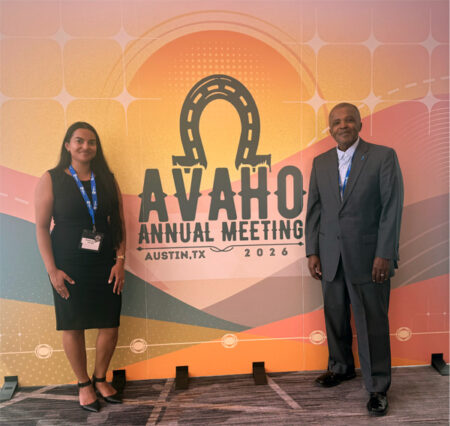
Simran Singh (Data Mgmt. & Research Manager) and Rob Taylor (GIST Advocate)
The Life Raft Group was invited to the 21st annual AVAHO Meeting in Austin, Texas. AVAHO stands for Association of Veterans Affairs (VA) Hematology/Oncology, and they focus on educational programs to improve the quality of care to veterans with cancer. Board member, Rob Taylor, and I were in attendance among 900 other attendees.
The meeting featured a range of educational seminars, each with a different focus. Attendees included nurses, pharmacists, dietitians, resident doctors, hematologists, oncologists, social workers, other healthcare professionals, and industry leaders, all united by a shared goal of improving care for the patients they serve.
I joined the conference with Rob to raise awareness of GIST and the LRG, and to explore how we can better support the patients they serve. Connecting with the VA has been a key goal of the LRG Health Equity Council, so this meeting was a valuable opportunity to move that work forward.
Throughout the meeting, I spoke with many wonderful Veterans Association (VA) representatives from across the country. Some had never heard of GIST while others were aware of GIST and had infrastructure in place to support GIST and other sarcoma patients. It was interesting to see how knowledge of GIST varied based on location. Rob and I also met with various industry partners who worked at different pharmaceutical companies and genomic and diagnostic companies to learn how they may support patients with GIST.
A few takeaways from this meeting were:
- Nurse navigators as patient advocates: Nurse navigators help patients navigate their care by connecting them to resources and helping them overcome obstacles. Because they often see patients more frequently than the treating physician, they are well positioned to share information about LRG.
- VA care and community care: Understanding how the VA works and how GIST is treated there will help us better support our veterans. When the VA cannot provide the care a patient needs, it refers them to community care, which uses providers in the community to fill those gaps.
- Molecular and genetic testing through the VA: Molecular and genetic testing is widely available through the VA. This is worth sharing with our VA community as they seek answers about their GIST and learn what treatment options may be available to them.
While I was impressed by the meeting and the care AVAHO brings to cancer patients, I also saw opportunities to improve outcomes for veterans with rare cancers.
One limitation of the VA is access to GIST-related clinical trials, and patients may be missing out on life-saving treatment if their options are limited.
The more we raise awareness of the LRG among nurse navigators, the more patients we can connect with and the sooner we can share timely resources. Through the LRG, patients can access a case manager who walks members (patients and caregivers) through their GIST journey, helping them better understand their diagnosis and providing guidance. We also offer educational webinars and resources, mentor programs, support groups, clinical trial awareness, and an extensive list of GIST specialists.
This meeting gave Rob and me a valuable inside look at how the VA operates, helping our organization strategize ways to better support veterans with GIST.