 Good things are worth waiting for! While the official launch of our new Patient Registry has moved from this summer to later this year, there is a lot to be excited about. The additional time will help us make sure the new Registry is ready to provide a better experience for patients and an even stronger resource for GIST research.
And there’s another exciting development to share! The LRG Patient Registry is taking on an even greater role in clinical research.
Since 2002, the LRG Patient Registry has been collecting the real-world experiences of people living with GIST. For more than two decades, patients have shared information about their diagnoses, mutations, treatments, side effects and outcomes, creating an incredibly valuable resource for understanding GIST.
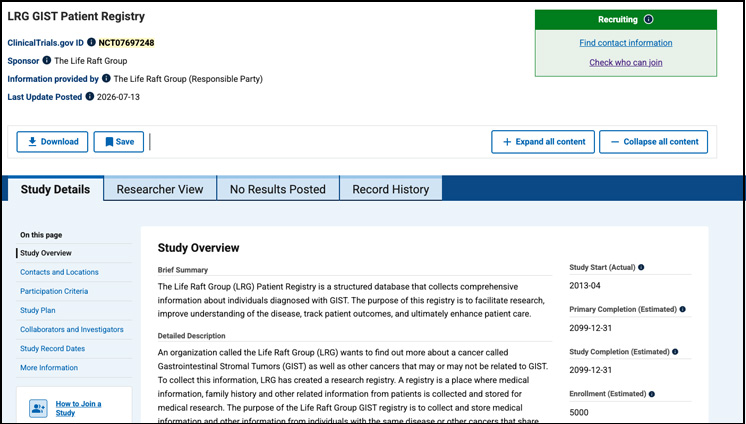
This summer marked a major milestone for the Registry. While it has long been an IRB-approved research study, the LRG Patient Registry is now listed as a clinical study on ClinicalTrials.gov.
This means the information patients contribute isn’t simply being collected in a database. It is part of a structured research study designed to help answer important questions about GIST.
More Than 20 Years of Patient-Powered Data
The strength of the LRG Patient Registry comes from something few traditional clinical trials can provide: the ability to follow the GIST experience over many years.
GIST isn’t a single disease with a single treatment path. Different mutations can behave differently and respond differently to treatment. Patients may receive several therapies during their lifetime, and their disease can change along the way.
By bringing these individual experiences together, the Registry gives researchers an opportunity to look for patterns across the GIST community.
They can explore questions about treatments and outcomes, mutations, disease progression, testing and other factors that may affect the GIST journey.
What Does It Mean to Be a Clinical Research Study?
For patients, this is an important distinction.
The LRG Patient Registry is an observational clinical research study. Unlike a treatment trial, patients aren’t assigned a drug or other intervention. Instead, the study observes and follows what happens to people with GIST in the real world.
The Registry operates under an established research protocol and IRB oversight, and participants provide informed consent. Its listing on ClinicalTrials.gov also makes the study visible as part of the broader clinical research landscape.
Most importantly, patients who participate in the Registry are participating in GIST research.
Why Your Participation Matters
A Registry is only as powerful as the information patients contribute.
One person’s experience can help answer a question. Hundreds or thousands of experiences collected over time can reveal patterns that might otherwise be difficult to see, especially in a rare cancer like GIST.
And because the LRG Registry has been collecting patient information since 2002, it offers something particularly valuable: years of longitudinal, real-world GIST data.
This data can also support laboratory-based research by helping researchers connect what they learn about GIST in the lab with patients’ mutations, treatments, disease progression and outcomes. Together, clinical and laboratory data can provide a more complete picture of how GIST behaves and help guide new research questions.
Every patient who joins adds to that knowledge. Every patient who returns to update their information makes the data stronger.
For more than two decades, GIST patients have helped build the LRG Patient Registry. Today, that patient-powered resource is helping drive clinical research that can deepen our understanding of GIST and help improve the future for everyone affected by it.
View the LRG Patient Registry study on ClinicalTrials.gov ->