
Driving Progress for SDH-Deficient GIST Research
Most GIST tumors are driven by mutations in the KIT or PDGFRA genes, and those cases usually respond well to targeted therapy like imatinib. SDH-deficient GIST is a rarer, distinct subtype: it lacks mutations in KIT or PDGFRA and instead loses function of an enzyme called succinate dehydrogenase, or SDH, often due to a mutation in one of the SDH genes that can sometimes run in families. This subtype tends to show up in younger patients, usually grows in the stomach, and does not respond to the standard GIST drugs the same way, which is why it needs its own dedicated research and its own treatment strategies.
Rare cancers rarely get the resources they deserve nor is there an urgency to expedite research and funding, which is exactly why The Life Raft Group created the SDH Consortium. This group brings together global leading researchers, oncologists, and patient advocates who focus on SDH-deficient tumors, including SDH-deficient GIST and paraganglioma/pheochromocytoma (PPGL), as well as bring external experts whose expertise can be applied to the SDH community so that discoveries move out of the lab and into real treatment options as quickly as possible. The Consortium is one of the clearest examples of The Life Raft Group’s mission in action: connecting science and the patient community around a disease that too often gets overlooked.
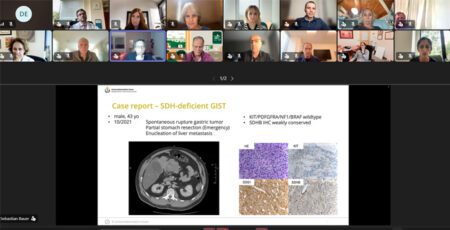 At the July 22 meeting, that mission showed up in every presentation. Dr. Alice Soragni, whose lab is now based at the University of Colorado Anschutz Medical Campus, shared how her team is growing organoids, small lab-made replicas of patients’ own tumors, to test drug responses faster and more affordably than ever before, including a promising early signal for a repurposed drug in PPGL. Dr. Hussam Alkaissi, from the National Institute of Child Health and Human Development, introduced a new, free platform called PPGLomics that gives researchers and doctors a much clearer window into the genetics of these rare tumors, with plans already underway to expand it to SDH-deficient GIST at The Life Raft Group’s request. Dr. Suzanne George, of Dana-Farber Cancer Institute, gave an encouraging update on the pemigatinib clinical trial for SDH-deficient GIST, now open at her institution and expanding to more sites across the country. Dr. Sebastian Bauer, of the West German Cancer Center at University Hospital Essen, shared a case study of an SDH-deficient GIST patient, whose cancer had stopped responding to every standard treatment, until deeper genetic testing uncovered a FGFR mutation that led his team to consider pemigatinib, which has demonstrated promise for the case presented . This highlighted the importance of additional testing and how to tackle resistance mutations.
Meetings like the SDH Consortium are possible because The Life Raft Group brings together investigators and experts who are advancing the field through laboratory discoveries, innovative data tools, clinical trials, and other research initiatives. By sharing knowledge, fostering collaboration, and connecting complementary areas of expertise, these meetings help inform one another’s work, accelerate progress, and move us closer to a cure.
If you are a patient or a caregiver with SDH-deficient GIST and would like to learn more about this consortium, please contact us at liferaft@liferaftgroup.org
You can also support SDH research by donating here.