The Life Raft Group is committed to enhancing the survival and quality of life for people living with Gastrointestinal Stromal Tumor (GIST), and other rare diseases, through patient-powered research, education and empowerment, and global advocacy efforts.
Other Programs Supported by The Life Raft Group:



PATIENT
Leverage patient perspective to drive innovative solutions in cancer research.
POWERED
Educate and empower patients to take a larger role in their care.

SCIENCE
Accelerate research outcomes through collaborative efforts.
FOR LIFE
Increase access to effective treatments worldwide.
Real World Evidence In Action
Traditional models for cancer research have resulted in many breakthrough treatments for patients, but it is not enough. The LRG’s approach to GIST research through real world evidence, relies on timely, accurate data from the patient’s perspective, with patient survival as the primary objective.



RECENT LRG DATA



Did you know that GIST is actually a family of cancers? Learn more about the science of GIST.

Update your Patient Registry Info.
Join The Life Raft Group.
Current GIST Clinical Trials.
Search the GIST Specialist Database.

Dr. Monica Anderson
Diagnosed in 2012 with Adult GIST.

Bella Rocco
Diagnosed in 2009 with Pediatric
(SDH-deficient) GIST.
HELP US SAVE LIVES
The Life Raft Group is a community and it is up to all of us to make a difference. There are many ways to help. We always need patient tissue and data in our GIST patient registry. Volunteering your time or making a monetary donation also helps us drive research forward and save lives.

News

Expert patient training program a success
The LRG is proud to announce that the inaugural class of our GIST Expert Patient Training Program has been completed. The class, which was open to GIST patients, caregivers, and other members oaf the extended GIST community, was comprised of just under 20 students and was a comprehensive offering designed to help participants better understand the science behind GIST.
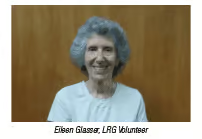
LRG member Eileen Glasser creatively networks to support GIST Awareness Day
As July 13’s GIST Awareness Day draws closer we are encouraging all of our members to make the day their own by spreading the word in their local communities. Raising awareness about GIST eases obstacles to education, treatment and research that make this disease so difficult to battle. GIST Awareness Day puts the power to help bring about this change in the hands of you, our members, who have been most profoundly touched by GIST.
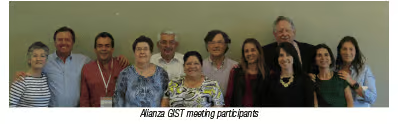
Alianza GIST meets in Zurich, Switzerland
Alianza GIST members from Argentina, Bolivia, Brazil, Colombia, Chile, Cuba, Venezuela, Guatemala, Mexico, and Spain joined representatives from the Life Raft Group in Zurich, Switzerland from May 14 to 17. The major focus of the meeting was to develop a new methodology in order to move towards Alianza GIST autonomy.
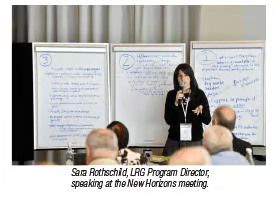
New Horizons Takes Place in Zurich, Switzerland
With the beautiful mountains of Switzerland and Lake Zurich in the background, 44 GIST Patient representatives from 28 countries and 32 patient groups/organizations convened in Zurich for the New Horizons GIST meeting from May 14-17, 2014.
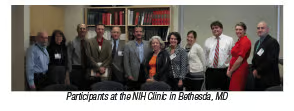
NIH Clinic provides support and a healthy dose of fun
The 12th Pediatric and Wildtype GIST Clinic was held May 21 to 23, 2014 at the National Institutes of Health in Bethesda, Maryland. Coordinated by Dr. Sosipatros Boikos, and based out of the NIH Pediatric Oncology Department under the direction of Dr. Lee Helman, the Clinic is collaboration between clinicians and researchers to collect data, investigate and develop treatment for GIST patients who do not have either c-KIT or PDGFRA mutation.

Poker for Hope proves to be huge success
On Saturday, May 17th in the Caesars Palace poker room in Las Vegas, the Poker For Hope charity tournament took place, benefiting Tia’s Hope, The Life Raft Group, and Phase One Foundation. Poker for Hope was started by these three non-profit cancer support organizations with ONE goal in mind…A CURE!

Promising future treatments for GIST after Tyrosine Kinase Inhibitors
A recent study by Margaret von Mehren, MD and Dr. Natthapol Songdej of Fox Chase Cancer Center discusses the role of new treatments for GIST

The Faces of We Are the Cure – Teena Petersohn
In December, 2013, the Life Raft Group launched its “We Are the Cure” campaign to fund GIST research in response to the shrinking pool of available funds. As a rare disease, GIST research is impacted more than other more common cancers like breast and colon. Institutions like the National Cancer Institute are funding just four to five percent of all research proposals which means that a rare cancer like GIST is lost amongst the roughly 200 cancers competing for funding.
Keep up with the latest news, events, and opportunities to help.
To contact The Life Raft Group, please call 973-837-9092
PARTNERS & AFFILIATIONS